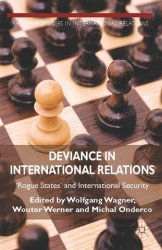

'Rogue states' have been high on the international security agenda for many years but their theoretical significance for International Relations has remained poorly understood. In contrast to the bulk of writings on 'rogue states' that address them merely as a policy challenge, this book focuses on what we can learn from deviance about the international system and international society.
Building on three basic insights developed in social constructivism and critical theory, this volume brings together interdisciplinary insights into the study of 'rogue states', exploring the role of comity and decency in labelling of 'rogue states', the impact labelling has on behaviour, how to treat a 'rogue state', how 'rogue' status can be withdrawn and what part the role of international law has to play in this process.
This unique and wide-ranging study will appeal to scholars of Sociology, Criminology, Political Science, International Relations and International Law. Review: The notion of 'rogue' states is vague, common and important in both discourse and policy. This fine collection of essays subjects it to careful scrutiny from a range of disciplines and perspectives, including looking at topics usually ignored like the agency of the 'rogues' themselves and how states can be 'de-rogued.' Careful and thought-provoking, this volume is of great value to IR scholars. - Robert Jervis, Adlai E.
Stevenson Professor of International Politics, Columbia University, New York By focusing on the labeling and disciplining of 'rogue states' by international society, and by building on the insights of social constructivism and critical theory, this volume sheds new and valuable light on the meaning of deviance in global politics.
It presents a valuable contribution to international relations scholarship. - Miroslav Nincic, Professor of Political Science, University of California, Davis
 Related Products
Loading similar products...

Stay informed about the best deals and price drops. Choose which notifications you'd like to receive from PriceCheck.


