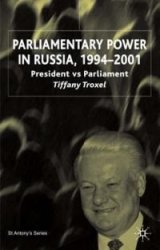

This is the first study of the Russian parliament's influence and power in the policy process from 1994 to 2001. Tiffany Troxel challenges the widely held view that during this period Russia operated under a presidential system with a strong, authoritarian leader who ruled by decree and a weak parliament which did not wield much power.
This book explains how relations between the executive and legislature fluctuated between confrontation and co-operation during this period. Explanations for this crucial trend include President Boris Yeltsin's failing health, the appointment of the Parliament's choice of Prime Minister Yeveniy Primakov, economic crises, Yeltsin's diminished public support, the enhanced ability of parliament to form coalitions and the ever-shrinking areas in which the President could issue decrees.
Parliament's assertion of power and its challenge to the executive's authority meant the introduction of significant checks and balances. This is of critical importance to the development and stability of democracy in Russia. Review: 'Tiffany Troxel masterfully traces the development of the Russian parliament's critical early years.
This is the best book of its kind and Troxel's work will be the benchmark for anyone studying the institutionalization of the Russian parliament.' David C. King, Associate Professor of Public Policy, Harvard University
Kindly note that PriceCheck is a discovery and comparison platform. Unfortunately, we are not able to give intensive advice or reviews as we do not stock the product.
 Related Products
Loading similar products...

Stay informed about the best deals and price drops. Choose which notifications you'd like to receive from PriceCheck.


