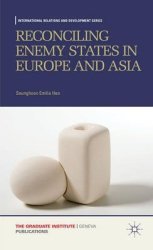

Rebuilding the relationship between enemy states is not an easy path. Moreover, the term 'reconciliation' has until now has been ill-defined in international relations. What do we mean by 'successfully reconciled'? Is it when national leaders shake hands on a red carpet or when economic interaction intensifies?
Or is reconciliation only accomplished when citizens regain mutual respect? Drawing from sources in English, French, Korean, Italian, German and Japanese, Heo establishes a model that clarifies why certain countries reconcile while others do not. Discussing historical and contemporary cases ranging from Europe to Northeast Asia, she gives a unique insight into various means of arriving at a genuine reconciliation.
Review: This book makes an outstanding contribution to analytical thinking on an important topic in interstate relations and provides a better understanding of relations between two societies marked by a deep historical antagonism. - Mohammad-Reza Djalili, Professor of International History and Politics, Graduate Institute, Switzerland Both students of international relations and peace practitioner will benefit from Heo's study and combined, will lead to an important contribution in building and expanding the culture of peace. - Mari Yamashita, Director, United Nations Information Centre (UNIC) Tokyo, Japan Striving to bridge disciplines and continents, Dr.
Heo's book is a welcomed addition to the rapidly expanding scholarship on conflict resolution and historical reconciliation. - Daqing Yang, Associate Professor of History and International Affairs, The George Washington University, Washington, USA The value of the book is to bring the perspective of reconciliation in the relations between states.
A further detailed application of her model to the case will be highly welcomed. - Hideaki Shinoda, Japanese Journal of Political Science
 Related Products
Loading similar products...

Stay informed about the best deals and price drops. Choose which notifications you'd like to receive from PriceCheck.


