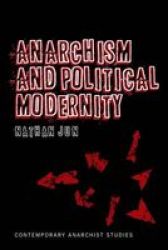
This book argues that anarchism should be considered the first postmodern philosophical and political movement and offers a revision of classical anarchism. Anarchism and Political Modernity looks at the place of classical anarchism in the postmodern political discourse, claiming that anarchism presents a vision of political postmodernity.
The book seeks to foster a better understanding of why and how anarchism is growing in the present. To do so, it first looks at its origins and history, offering a different view from the two traditions that characterize modern political theory: socialism and liberalism. Such an examination leads to a better understanding of how anarchism connects with newer political trends and why it is a powerful force in contemporary social and political movements.
This new volume in the Contemporary Anarchist Studies series offers a novel philosophical engagement with anarchism and contests a number of positions established in postanarchist theory. Its new approach makes a valuable contribution to an established debate about anarchism and political theory. It offers a new perspective on the emerging area of anarchist studies that will be of interest to students and theorists in political theory and anarchist studies.
Contemporary Anarchist Studies promotes the study of anarchism as a framework for understanding and acting on the most pressing problems of our times. The series publishes cutting edge, socially-engaged scholarship from around the world - bridging theory and practice, academic rigor and the insights of 'contemporary activism.' Review: This book stands out among works of the emerging new generation of anarchist theorists.
Unlike much of the trendy post-anarchism, it is firmly grounded in political philosophy and the history of anarchist thought. Jun shows that ideas often seen as bold new post-modern innovations above all, the critique of representation are in fact deeply rooted in the anarchist tradition. He debunks the equation of classical anarchist theory with the weakest aspects of modernism and shows anarchism to be a powerful radical tradition that goes beyond the limits of conventional liberalism and socialism.
Jun presents strong evidence that anarchism is now becoming most the promising theoretical alternative within the dissident academy. John P. Clark, Gregory Curtin Distinguished Professor of Humane Studies and the Professions and Professor of Philosophy, Loyola University.




 Related Products
