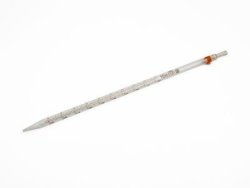
Graduated markings: These markings indicate the volume of liquid contained in the pipette and allow for precise measurements.
Tapered tip: The tip of the pipette is tapered to easily fit into small openings and to facilitate the release of liquid drops.
Bulb or pump: Graduated pipettes can have a rubber bulb or a pump to create suction and draw liquid into the pipette.
Calibration: Graduated pipettes are calibrated to a specific volume, allowing for accurate measurements.
Material: These pipettes are typically made of glass, which is durable and can withstand chemical reactions.
Accuracy: While not as precise as volumetric pipettes, graduated pipettes still have a high level of accuracy for most laboratory applications.
Easy to use: Graduated pipettes are easy to use and require minimal training, making them suitable for both beginners and experienced laboratory technicians.
Versatility: These pipettes can be used for various liquids, including aqueous solutions, oils, and organic solvents.
Cost-effective: Graduated pipettes are more affordable than volumetric pipettes, making them a cost-effective option for laboratories on a budget.
Disposable options: Some graduated pipettes are designed for single-use, making them convenient for tasks that require frequent changes of
+5 more

 Related Products


