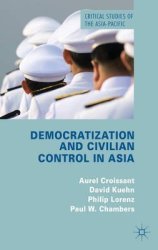

| Manufacturer | Palgrave Macmillan |
Civilian control of the military is intricately linked to democratic rule. The authors analyse civil-military relations in new democracies of East, Southeast and South Asian nations, beginning by proposing a new conceptual and theoretical framework to identify the status of civilian control in newly established democracies and to explain changes over time.
Based on this framework, they then trace the interrelated development of civil-military relations and democratic institutions in Bangladesh, Indonesia, Pakistan, the Philippines, South Korea, Taiwan, and Thailand. By comparing the insights gained from the case studies, they then identify patterns and differences in the relationship between civilian control over the military and democratic quality and consolidation.
While establishing civilian control of the military is a necessary condition for a functioning democracy, it requires prudent strategic action on the part of the civilian decision-makers to remove the military from positions of power and make it follow their orders. Review: 'This is an excellent book about democratic governance of the military in Asia, written by authors with a solid academic reputation on the issue of civil-military relations.
The book gives interesting concepts, insights and entry points for security sector reform and its relation with democratic consolidation in the region. Governmental readers should be sobered, and non-governmental ones energised, by this timely book.' - Hans Born, Geneva Centre for the Democratic Control of Armed Forces, Switzerland 'This is a seminal work on the comparative analysis of civilian control of the military in Asian new democracies.
Analytically innovative, empirically rigorous, and rich in policy implication. The book is the 'must' reading for students of Asian politics and comparative analysis of civil-military relations.' Chung-in Moon, Professor of Political Science, Yonsei University, South Korea 'This excellent monograph contributes tremendously to our understanding of at least two major issues.
In raising and answering the three main questions of achieving democratic civilian control of the military in any country - the challenges facing civilians, diminishing military prerogatives and achieving control, and the risks of failure - the authors provide unparalleled insights into the successes, and failures, of democratic consolidation in countries ranging from South Korea and Taiwan to Thailand and Pakistan.' - Thomas C.
Bruneau, Distinguished Professor of National Security Affairs, Naval Postgraduate School, Monterey, California, USA
 Related Products
Loading similar products...

Stay informed about the best deals and price drops. Choose which notifications you'd like to receive from PriceCheck.


