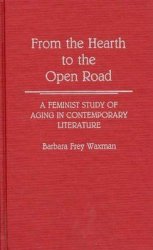

This literary critical book deals exclusively with contemporary fiction by women that focuses on aging of women. It discusses the emergence of a new fictional genre, the novel of ripening or Reifungsroman. This emerging genre about the aging heroine reconceptualizes middle and old age for women, taking it from a formerly stereotypical state of passivity and deterioration (by the hearthside) into one of adventure, growth, self-discovery, self-affirmation, and integration (on the open road).
The book contains an extensive bibliography of twentieth-century popular periodical articles on aging (Canadian, American, and British); literary critical articles on aging in the fiction of Doris Lessing, Alice Adams, Paule Marshall, Elizabeth Taylor, Barbara Pym, May Sarton, and Margaret Laurence; as well as general literary critical works on these authors; and some general (non-literary) studies of aging, often from a feminist framework (such as Simone de Beavoir's The Coming of Age).
Using a feminist theoretical approach, with some influence from social literary critics such as Lentricchia and Said, the book surveys, in the first chapter, selected popular magazine articles written over this century. The next chapter analyzes fiction on middle-aged women, in works by Doris Lessing and Alice Adams.
Chapter Three analyzes young-old women, in works by Barbara Pym, Elizabeth Taylor, and Paule Marshall. The final chapter looks at frail, or dependent old women, in works by May Sarton and Margaret Laurence. This work should be well received by students and scholars engaged in the study of literary criticism, women's studies in literature, gerontology, the life-cycle in literature, and contemporary women in literature.
Review: ?Waxman traces the changing image of aging women in popular magazines and fiction. She asserts that a new genre is emerging, which she dubs the Reifungsroman, or 'novel of ripening.' She compares this to the more familiar term Bildungsroman, as each kind of fiction portrays a character's growth, but at a different stage of life.
The characteristics of this new genre, according to Waxman, include a confessional tone, a rambling narrative, exploration of sexual passion, a journey/quest motif, the desire to name, and dreams/flashbacks that allow the character to come to terms with her past. The establishment of this new genre and the creation of a bibliography are the most valuable aspects of the book.
Waxman's analysis of individual works of fiction is competent but lacklustre, offering few new insights. She includes the following writers: Doris Lessing, Alice Adams, Elizabeth Taylor, Barbara Pym, Paule Marshall, Margaret Laurence, and May Sarton; she devotes her opening chapter to the depiction of old age in periodical literature of 1890-1920 and of 1950-1980s, establishing a backdrop for her discussion of contemporary fiction.
The overall impact of Waxman's book is to point out a rather dramatic move away from ageism in recent fiction by and about women.?-Choice
 Related Products
Loading similar products...

Stay informed about the best deals and price drops. Choose which notifications you'd like to receive from PriceCheck.


