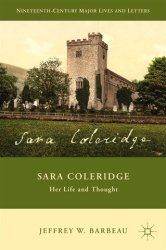

Sara Coleridge: Her Life and Thought explores the biographical and intellectual history of Sara Coleridge (1802-52), a writer whose greatest works never appeared in print. Known to the public as the daughter of S. T. Coleridge and author of a few modest publications - a small collection of children's poems, translations of popular travel literature, and an innovative fairy tale - Sara's many unpublished manuscripts, letters, and other writings reveal an original thinker in dialogue with leaders of the Oxford Movement as well as other major literary and cultural figures in nineteenth-century England.
Sara's writings on beauty, education, imagination, faith, the Bible, and suffering in life and death uncover new aspects of Romantic and Victorian literature, history, philosophy, and theology. Review: Sara Coleridge has been consistently underrated in the past, and Jeffrey W. Barbeau's fine study does much to redress the balance. - John Beer, Professor of English Literature, University of Cambridge, UK Sara Coleridge has been known as the daughter of her father, the poet-philosopher Samuel Taylor Coleridge, and the defender of his reputation in the next generation.
Jeffrey W. Barbeau does not diminish the importance of these roles, but he shows in this book how fully Sara acted as a participant in the theologico-metaphysical debates of her day. Taking issue with the Oxford Movement, she wrote penetratingly on the salient religious issues of the time such as the nature of regeneration.
We can now clearly see Sara as an independent and creative intelligence. - David Bebbington, Professor of History, University of Stirling, UK Jeffrey W. Barbeau's sparkling critical introduction to Sara Coleridge proclaims her significance as one of the foremost intellectuals of her time. Moving beyond her poetry for children and editorial work, Barbeau presents a philosophically energetic and lively woman who's hitherto neglected writings on theology, education, illness, aesthetics, and the Bible confirm her significance within late Romanticism and nineteenth-century culture.
Whether critiquing Tractarianism and Roman Catholicism, or defending her father's biblical hermeneutics, Coleridge's writing is revealed as both captivating and discerning in a study that promises to inaugurate further scholarship on this much overlooked thinker and critic. - Emma Mason, Professor of English and Comparative Literary Studies, University of Warwick, UK
 Related Products
Loading similar products...

Stay informed about the best deals and price drops. Choose which notifications you'd like to receive from PriceCheck.


