
| Manufacturer | Praeger |
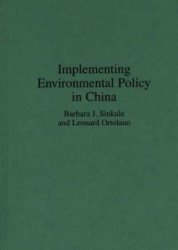
In the 1980s, China established its first systems of environmental management collectively known as the three magic weapons: environmental impact assessment, pollutant discharge fees, and the three synchronizations. The authors explore the successes and failures of these systems through actual investigation of individual factories.
They also examine the key agencies that implement environmental policy and their responsibilities to both leaders of local government and China's National Environmental Protection Agency. Their findings provide intriguing insights into the broader issues of environmental goals and priorities in developing countries, and the roles of both government agencies and entrepreneurs in policy implementation.
Review: A uniquely valuable reference for readers interested or involved in China's environmental protection and economic development, including policy makers, businesspersons, researchers, and students. - Choice [I]s very useful and accessible to all readers. It provides a valuable insight into the theory and practice of China's environmental policies... [A]n excellent book for anyone, regardless of background, interested in China's environmental policies and their application. - International Review Network [O]ffers readers interesting information presented in well-organized and clearly-written prose.
The book analyzes the process of policy implementation and facilitates future research by helping to define questions for further investigation. IEPC presents a valuable series of case studies that should inspire further study of environmental policy implementation in China. - Ecology Law Quarterly Presents the results of a study of the implimentation of a set of enviromential policies in a small region in South China. - Abstracts of Public Administration, Development, and Enviroment
 Related Products
Loading similar products...

Stay informed about the best deals and price drops. Choose which notifications you'd like to receive from PriceCheck.


