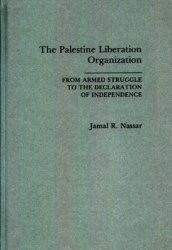

This book takes a comprehensive look at the PLO, examining its origins, legal status, goals, and strategies. Jamal R. Nassar investigates the PLO's role in regional and international politics and unveils the dynamics of the power relationships responsible for the organization's successes and failures.
The book discerns patterns and trends in the PLO's activities and studies the conditions under which these patterns and trends develop. Nassar places the PLO in a global perspective, delving into the basis of the organization's legitimacy and its prospects for participation in the peaceful resolution of the Arab-Israeli conflict.
The book's organization and comprehensive coverage--beginning with a thorough historical background of the Palestinian experience--make it an excellent study for the student of Middle Eastern politics. Nassar probes the rise of the PLO to its present position as a major actor in the Middle East--one that is no less significant than a number of sovereign states.
He shows that the PLO is a complex power that cannot hope to achieve its objectives independently of other regional powers but can prevent these powers from resolving the Arab-Israeli dispute. The book outlines the many peace initiatives that have been foiled by the PLO and reveals how Israel's refusal to talk to the PLO will likely thwart the achievement of peace.
Students and scholars of Middle East and Palestinian politics, the Arab-Israeli conflict, terrorism, political ideologies, revolutionary movements, transnational politics, and contemporary history will find Jamal Nassar's book on the PLO an invaluable resource. Review: ?Nassar's treatment of the PLO is comprehensive and well documented.
The author's previous works and demonstrated interest in Israel and Palestine are evident in this study, which provides useful and important insights concerning the PLO's origins and political agenda. The PLO's relationship with the Arab states is particularly instructive since neither the Arab world nor the PLO are viewed (quite correctly) as monoliths.
The author notes variants of nationalism (e.g., the first chapter discusses Palestinian Arab Nationalism ) and provides a useful analysis of the relationship between and views of Israelis and Palestinians (Chapter 7). He also distinguishes between different Israeli points of view on Palestine as well as the occasional gap between positions of the Israeli government and Israeli public opinion.
He reviews the PLO's relationship with the international community, suggested by its recognition by the UN, support from most of the Third World, and a modicum of sympathy in Israel itself, which make the PLO a major actor. Chapter footnotes, selected bibliography, and index. An excellent source for students of the Arab-Israeli conflict, comparable to Yehoshafat Harkabi's Palestinians and Israel.?-Choice
 Related Products
Loading similar products...

Stay informed about the best deals and price drops. Choose which notifications you'd like to receive from PriceCheck.


