
| Brand | Unbranded |
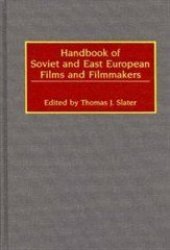
One of the most fascinating aspects of film studies is how it can explain more about the nature of closed societies. In Eastern Europe, artists, intellectuals, and entertainers are now free to create film outside the direct control of the state. This unique handbook convincingly shows how much film art was still being produced behind the Iron Curtain even during such repressive periods as those under Stalin and Brezhnev.
Thomas J. Slater has compiled a valuable history of cinematic evolution in the Soviet Union and Eastern Europe through the use of detailed historiographical essays for each country. The dramatic changes in the political and economic structures of Eastern Europe that occurred during 1989-90 have revealed even more about courageous filmmakers who worked under difficult conditions.
Many were still able to produce artistically important films, but filmmakers were often forced to become propagandizers for their authoritarian governments. This book outlines the film achievements in the Soviet Union, Poland, Czechoslovakia, Yugoslavia, Hungary, East Germany, Romania, and Bulgaria, and how their people responded to the films they were allowed to see.
An appendix contains a chronology of major historical, cultural, and film events in the Soviet Union and Eastern Europe during the past 100 years. This book will be of great value to scholars not only of film studies, but also of history, social and political science, communications, culture, and the fine arts.
The handbook is an excellent addition to the collections of academic and public libraries and provides a vital listing for film historians and filmmakers. Review: ?In surveying the film output of seven East European countries and the (former) Soviet Union to 1990, this handbook is well timed to summarize the full period during which communist governments controlled the cinema of the region.
Each of the countries (Soviet Union, Poland, Czechoslovakia, Yugoslavia, Hungary, East Germany, Romania, and Bulgaria) is treated in a separate chapter, containing a general essay, bibliography, brief biographical sketches of key persons (primarily directors), and selected filmography. Emphasis is on feature-length fictional films; shorts, animations, and documentaries are generally excluded.
Two indexes are provided: a film index with both foreign and translated versions of film titles, and a subject index covering individuals as well as topics such as World War II and Hungarian Revolution (1956). An overall chronology of major historical, cultural and film events of the region is also included.
A useful addition to the literature since earlier books on the topic are not organized as reference works; recommended for strong film collections in upper-division undergraduate and university libraries.?-Choice
 Related Products
Loading similar products...

Stay informed about the best deals and price drops. Choose which notifications you'd like to receive from PriceCheck.


