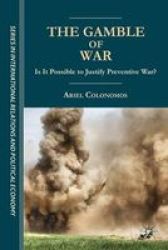

With the new millennium, prevention has become a popular doctrine in international politics. One of its most noticeable features is that democracies become inclined to strike first. In the US, it has served as the banner of the neo-conservative movement but it also gathered support from some liberals.
It has also inspired several Israeli interventions. Does the preventive use of force meet the normative criteria that prevail or should prevail in a democratic system? Or does it endanger the legal and ethical traditions that characterize the history of Western military ethics? This book analyzes the justification of preventive war in contemporary asymmetrical international relations.
It focuses on the most crucial aspect of prevention: uncertainty. Luck plays a significant role in these hazardous preventive wars, with unforeseen and sometimes unforeseeable consequences. This book bridges the explanatory analysis of uncertainty in preventive war making (using field work and data) with a normative account of prevention.
It builds a new framework where the role of luck - whether military, political, moral, or normative - is a corrective to the traditional approaches of the Just War tradition. Review: As Ariel Colonomos shows in this penetrating book, the fog of war is never thicker than when states contemplate preventive force.
Mixing astute commentary on history, ethics, political theory and current events, he offers very wise counsel to political leaders contemplating whether to attack before (they think) they will be attacked. -Michael Doyle, author of Striking First and Harold Brown Professor of U.S. Foreign and Security Policy at the School of International and Public Affairs, the Department of Political Science, and the Law School, Columbia University A brilliant exploration of the vexatious necessity of justifying preventive war when the availability of weapons of mass destruction excludes waiting for an attack to materialize but when uncertainty about the future excludes a 'proportional' response to an attack whose extent is unknown because it has not yet occurred. - Stephen Holmes, Professor of Law and Political Science, New York University
 Related Products
Loading similar products...

Stay informed about the best deals and price drops. Choose which notifications you'd like to receive from PriceCheck.


