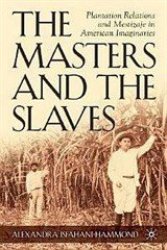

The Masters and the Slaves theorizes the interface of plantation relations with nationalist projects throughout the Americas. In readings that cover a wide range of genres--from essays and scientific writing to poetry, memoirs and the visual arts--this work investigates the post-slavery discourses of Brazil, the United States, Cuba, Puerto Rico, Haiti and Martinique.
Indebted to Orlando Patterson's Slavery and Social Death (1982) and Paul Gilroy's The Black Atlantic (1993), these essays fill a void in studies of plantation power relations for their comparative, interdisciplinary approach and their investment in reading slavery through the gaze of contemporary theory, with particularly strong ties to psychoanalytic and gender studies interrogations of desire and performativity.
This collection presents a comparative study of the impact of slavery on the literary and cultural imagination of the Americas, and also on the impact of writing on slavery on the social legacies of slavery's history. The chapters examine the relationship of slavery and master/slave relations to nationalist projects throughout the Americas - the ways in which a history of slavery and its abolition has shaped a nation's identity and race relations within that nation.
The scope of the study is unprecedented - the book ties together the entire 'Black Atlantic', including the French and Spanish Caribbean, the US, and Brazil. Through reading texts on slavery and its legacy from these countries, the volume addresses the eroticization of the plantation economy, various formations of the master/slave dialectic as it has emerged in different national contexts, the plantation as metaphor, and the relationship between texts that use cultural vs biological narratives of mestizaje (being interracial).
These texts are examined with the goal of locating the origins of the different notions of race and racial orders that have arisen throughout the Americas. Isfahani-Hammond argues that without a critical revisiting of slavery and its various incarnations throughout the Americas, it is impossible to understand and rethink race relations in today's world.
Review: Superb scholarship..a landmark work, an essencial source of knowledge for those who venture into the history, culture, and social life of the Afro-Atlantic world. --Antonio Benitez-Rojo, Amherst College The Masters and the Slaves redresses the stunning and disappointing dearth of studies of cultural theory in the Americas that are willing to look critically at the ideological uses of mestizaje as normative in the formation of the hemisphere's racial democracies.
Focused on but by no means limited to Brazilian cultural theory, the essays in this volume help to resituate discussions of slavery's racial and social legacies in a much deeper south than is found even in the more recent comparative studies of literature in the Americas. Together they make a compelling case for rethinking the theoretical meanings and uses of mestizaje in American histories. -- George Handley, Professor of Classics and Comparative Literature, Brigham Young University This is an excellent anthology.
Containing provocative and theoretically sharp essays, it is an incisive and timely contribution to a growing and increasingly important field - the comparative analysis of slave and race relations in southern and northern Americas and the Caribbean. Critically deploying the varied ideological and political functions of mestizaje, The Masters and the Slaves provides a powerful critique of the exclusionary white-black racial binary that tends to dominate U.S.-centered discourse on slavery. --Abdul JanMohamed, English Department, University of California at Berkeley
 Related Products
Loading similar products...

Stay informed about the best deals and price drops. Choose which notifications you'd like to receive from PriceCheck.


