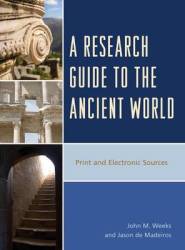

The archaeological study of the ancient world has become increasingly popular in recent years. A Research Guide to the Ancient World: Print and Electronic Sources, is a partially annotated bibliography. The study of the ancient world is usually, although not exclusively, considered a branch of the humanities, including archaeology, art history, languages, literature, philosophy, and related cultural disciplines which consider the ancient cultures of the Mediterranean world, and adjacent Egypt and southwestern Asia.
Chronologically the ancient world would extend from the beginning of the Bronze Age of ancient Greece (ca. 1000 BCE) to the fall of the Western Roman Empire (ca. 500 CE). This book will close the traditional subject gap between the humanities (Classical World; Egyptology) and the social sciences (anthropological archaeology; Near East) in the study of the ancient world.
This book is uniquely the only bibliographic resource available for such holistic coverage. The volume consists of 17 chapters and seven appendixes, arranged according to the traditional types of library research materials (bibliographies, dictionaries, atlases, etc.). The appendixes are mostly subject specific, including graduate programs in ancient studies, reports from significant archaeological sites, numismatics, and paleography and writing systems.
These extensive author and subject indexes help facilitate ease of use. Review: The study of the ancient Mediterranean, Egypt, and the Near East continues to be a mainstay of Western education, generating a large volume of scholarship. This guide by Weeks and Medeiros focuses on the monographs, books, journals, and electronic resources written primarily in Western European languages, Greek, or Hebrew that treat the history and prehistory of the region.
As the authors state, the guide cannot be considered comprehensive because of the enormous literature of the field. To warrant inclusion, works were judged by their availability, scholarly significance, and subject matter. In separate chapters, the authors discuss specialized library and museum collections, subject and regional bibliographies, dictionaries, encyclopedias, handbooks, abstracts and indexes, journals, biographical information, directories of organizations and associations, atlases, photographic and visual collections, and theses and dissertations.
Several appendixes provide additional helpful information, such as relevant graduate programs, sources on paleography and writing systems, and numismatics. The most useful appendix, however, is the list of archaeological site reports arranged by country and then by site. Because of the scope of the work, some omissions are inevitable, yet for those libraries that support programs in classics, archaeology, ancient history, biblical studies, and related fields, this guide must be considered a required purchase.
Summing Up: Highly recommended. Upper-division undergraduates, graduate students, researchers/faculty. CHOICE Weeks and de Medeiros have done a great service for students of the ancient world, making the vast scholarly literature on the subject much more manageable. The clear organizing principles behind this research guide mean that those who are new to the study of antiquity or those experts who want to broaden their understanding beyond their own region of specialization can very quickly immerse themselves in the scholarly literature.
With the increasing specialization of ancient studies, a research guide like this adds a much needed level of accessibility to a field that has become very complex and very regionally focused. It is particularly useful in that it is not just a bibliography confined to major works but offers guidance about libraries, institutes, photographic collections, and academic organizations. -- Kevin M.
McGeough, University of Lethbridge, Canada
 Related Products
Loading similar products...

Stay informed about the best deals and price drops. Choose which notifications you'd like to receive from PriceCheck.


