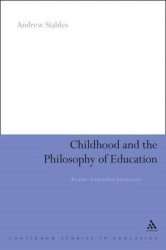
Philosophical accounts of childhood have tended to derive from Plato and Aristotle, who portrayed children (like women, animals, slaves, and the mob) as unreasonable and incomplete in terms of lacking formal and final causes and ends. Despite much rhetoric concerning either the sinfulness or purity of children (as in Puritanism and Romanticism respectively), the assumption that children are marginal has endured.
Modern theories, including recent interpretations of neuroscience, have re-enforced this sense of children's incompleteness. This fascinating monograph seeks to overturn this philosophical tradition. It develops instead a fully semiotic perspective, arguing that in so far as children are no more or less interpreters of the world than adults, they are no more or less reasoning agents.
This, the book shows, has radical implications, particularly for the question of how we seek to educate children. One Aristotelian legacy is the unquestioned belief that societies must educate the young irrespective of the latter's wishes. Another is that childhood must be grown out of and left behind.
Thus adults, as well as children, are impeded by the incompleteness thesis. The study will examine critically the bases for the beliefs that more and more compulsory education is necessarily a social good, and that adulthood should be conceived as an entirely separate realm from childhood. Review: 'What would it mean for our thinking about education, and in particular, our institutional arrangements for children's education, were we to think of children not as incomplete, or unprepared for the separate world of adults, but as semiotic engagers in life alongside adults?
Andrew Stables explores the radical implications of this question in a lively and accessible manner, offering, along the way, a fascinating account of some central themes in the history and philosophy of childhood, and addressing the implications for our conceptualization of childhood and adulthood of some important strands in contemporary social and political theory, including environmental ethics, post-humanism and post-modernism.
Whether or not one is convinced by Stables' claim that a reconceptualization of childhood is due, his analysis certainly offers a stimulating challenge to some existing conceptualizations.' Judith Suissa, Senior Lecturer in Philosophy of Education, Institute of Education, University of London, UK




 Related Products
