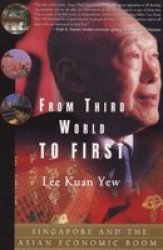
Few gave tiny Singapore much chance of survival when it was granted independence in 1965. How is it, then, that today the former British colonial trading post is a thriving Asian metropolis with not only the world's number one airline, best airport, and busiest port of trade, but also the world's fourth-highest per capita real income?
The story of that transformation is told here by Singapore's charismatic, controversial founding father, Lee Kuan Yew. Rising from a legacy of divisive colonialism, the devastation of the Second World War, and general poverty and disorder following the withdrawal of foreign forces, Singapore now is hailed as a city of the future.
This miraculous history is dramatically recounted by the man who not only lived through it all but who fearlessly forged ahead and brought about most of these changes. Mr. Lee is one of the most respected political figures in the world today ("Time" and "Newsweek" regularly profile his socio-economic strategies and his regime), and recognition of his name among academic, political, historical and sociological circles is guaranteed.
This volume also features a foreword from Dr. Henry Kissinger.
In this memoir, the man most responsible for Singapore's astonishing transformation from colonial backwater to economic powerhouse describes how he did it over the last four decades. It's a dramatic story, and Lee Kuan Yew has much to brag about.
To take a single example: Singapore had a per-capita GDP of just $400 when he became prime minister in 1959. When he left office in 1990, it was $12,200 and rising. (At the time of this book's writing, it was $22,000.) Much of this was accomplished through a unique mix of economic freedom and social control.
Lee encouraged entrepreneurship, but also cracked down on liberties that most people in the West take for granted--chewing gum, for instance. It's banned in Singapore because of "the problems caused by spent chewing gum inserted into keyholes and mailboxes and on elevator buttons." If American politicians were to propose such a thing, they'd undoubtedly be run out of office.
Lee, however, defends this and similar moves, such as strong antismoking laws and antispitting campaigns: "We would have been a grosser, ruder, cruder society had we not made these efforts to persuade people to change their ways.... It has made Singapore a more pleasant place to live in. If this is a 'nanny state,' I am proud to have fostered one." Lee also describes one of his most controversial proposals: tax breaks and schooling incentives to encourage educated men and women to marry each other and have children. "Our best women were not reproducing themselves because men who were their educational equals did not want to marry them....
This lopsided marriage and procreation pattern could not be allowed to remain unmentioned and unchecked," writes Lee. Most of the book, however, is a chronicle of how Lee helped create so much material prosperity. Anticommunism is a strong theme throughout, and Lee comments broadly on international politics.
He is cautiously friendly toward the United States, chastising it for a "dogmatic and evangelical" foreign policy that scolds other countries for human-rights violations, except when they interfere with American interests, "as in the oil-rich Arabian peninsula." Even so, he writes, "the United States is still the most benign of all the great powers.... [and] all noncommunist countries in East Asia prefer America to be the dominant weight in the power balance of the region." From Third World to First is not the most gripping book imaginable, but it is a vital document about a fascinating place in a time of profound transition. --John J.
Miller




 Similarly Tagged Products
