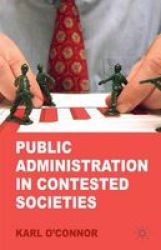

| Model Number | 9781137298140 |
The management of conflict has long been of concern to social scientists, urban planners and community-minded citizens. While differing mechanisms of managing ethno-national or ethno-linguistic tensions exist, few studies advance our understanding of how conflicts are actually managed - in other words, the study of ethnic peace.
Public Administration in Contested Societies draw on the experiences of two differing examples of ethnic peace: Belfast and Brussels in the expectation that other contested cities such as Kirkuk, Jerusalem, Nicosia or Mostar, who may one day consider power-sharing as a form of governance, may learn from what have been categorised as sites of successful power-sharing.
While there are few studies of ethnic peace, fewer studies again seek to understand the role of the elite level bureaucrat in sustaining this peace. The book ascertains the extent of discretion available to the bureaucratic elite and further, through determining core beliefs, establishes how this discretion is employed.
Review: This book is based on important and original research exploring the governance of contested societies, in particular Brussels and Belfast. O'Connor brings a fresh approach to an age old problem; how can different peoples live together in peace while faced with conflict? He explores the role of the elite level bureaucrats and in particular the role they play via representative bureaucracy, in delivering services through a system of multi-level governance and complex networks of policy makers and service deliverers.
It is an important book and one that students and practitioners of governance, conflict and security would be well advised to read. Andrew Massey, Department of Politics, University of Exeter, UK. In this tempting approach to the role of bureaucracy in conflict management, Karl O'Connor illustrates the active role of the bureaucratic elite in the shadow of the political discourse.
He opens a promising new research dimension in the analysis of contested societies and their complex pacification mechanisms. Rudi Janssens, Department of History, Free University of Brussels, Belgium Taking Belfast and Brussels as examples of divided cities, the author explores the environment in which bureaucrats interact with elected politicians.
His working assumption is that administrative capacity is not only necessary for attaining goals of good governance, but also for sustaining power-sharing agreements. O'Connor writes lucidly, engaging the reader's attention throughout, and making a valuable contribution to our understanding of how 'divided cities' meet daily challenges.
The book will enlighten and absorb researchers and practitioners alike. Edward Moxon-Browne, Professor (Emeritus) of European Integration at the University of Limerick, Ireland
 Related Products
Loading similar products...

Stay informed about the best deals and price drops. Choose which notifications you'd like to receive from PriceCheck.


