
| Brand | Unbranded |
Immediately after Bloody Sunday (1972) newspaper coverage employed the metaphor of the Holocaust to interpret the shooting dead of thirteen civilians while peacefully marching against internment in Derry, Northern Ireland. This early global idiom virtually disappeared in the 1970s and 1980s and made a surprising comeback in the 1990s.
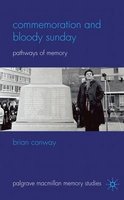
In Commemoration and Bloody Sunday, Brian Conway uses the case of Bloody Sunday as a window onto the way sociologists theorize about the 'making' of memory and changing interpretations of the past. Focusing on the role of agency, contexts and temporality, and drawing on original empirical data from interviews, archival research and participant observation, he examines early interpretative struggles between Irish republicans and civil rights activists over the meaning of the event and how this was de-politicized in the 1990s in the quest for power to define the truth of what happened.
Although the case that Conway examines has special relevance to our understanding of difficult pasts in Northern Irish society, it also has application to broader debates in collective memory. The author highlights the layered nature of memory work; discursive battles over ownership of the past; the changeable nature of embodied remembrance and its relation to textual memory; the relationship between local contexts and international conditions in shaping commemorative strategies; and the use of different genres in remembering the past.
Review: 'Brian Conway's Commemoration and Bloody Sunday is an exemplary account of the memory of trauma. As he explains how the reality of trauma limits the effects of agency, contexts, and narrative, Conway reorients collective memory scholarship from an interest-driven model of constructions toward a more precise, data-driven, model of meaning, distortion, and reality.
If one book best represents the new generation of memory theory and research, it is Commemoration and Bloody Sunday.' - Professor Barry Schwartz, Department of Sociology, University of Georgia, USA 'A rich account which C. Wright Mills would have approved of, linking private troubles and public issues.
The career of Bloody Sunday commemoration is mapped out with precision. Brian Conway portrays collective memory as virtually a living thing, changing to accommodate developments in the aspirations and goals of those who continue to remember the original traumatic event.' - Bill Rolston, School of Sociology, University of Ulster, UK
 Related Products
Loading similar products...

Stay informed about the best deals and price drops. Choose which notifications you'd like to receive from PriceCheck.


